Maintenance and Cleaning Guide for Faux Plants in Commercial Retail Spaces
Maintenance and cleaning usually become a buying question before they become an operations problem.
Retail buyers do not only ask whether faux plants look realistic on day one. They also ask how quickly dust shows, whether store staff can clean the foliage easily, and whether the display can stay presentable near windows, entrances, food areas, or high-traffic walkways.
From our side as a supplier, a practical maintenance plan starts before the order is placed. It depends on material, foliage density, finish, placement, and how often the display will be handled.
If your team is already comparing MOQ, samples, material direction, or project fit, the fastest next step is Send Inquiry.

Who this guide is for
We wrote this guide for:
- importers and wholesalers who need lower-maintenance artificial greenery for resale
- retail display teams that reset windows, shelves, and entrances on a schedule
- hospitality buyers who need faux plants to stay clean in guest-facing areas
- commercial project buyers who want realistic styling without creating a heavy upkeep burden
If you want the broader product range first, start with Products.
If you want supplier and export support first, use Wholesale of Artificial Plants.
Maintenance questions usually start before bulk order
In B2B discussions, buyers usually want to know:
- how often dust will become visible
- whether the foliage can be cleaned by store or facility staff
- whether the plant can be wiped, air-dusted, or lightly washed
- whether the finish is suitable for windows, entrances, or brighter public areas
- whether spare pieces or repeat orders can stay aligned with the approved sample
These are not after-sales questions only. They affect which product direction makes sense before sample approval.
1. Daily and weekly cleaning should stay simple
For most indoor commercial projects, the first target is not "zero maintenance." The real target is easy maintenance.
That usually means choosing faux plants that can handle:
- light dusting with a microfiber cloth or feather duster
- low-pressure air cleaning for tighter foliage areas
- basic reshaping after unpacking or routine handling
In practice, easier cleaning often comes from the product direction itself:
- smoother leaf surfaces are easier to wipe
- very dense foliage usually looks fuller but can trap more dust
- heavily textured finishes may need more careful handling
- oversized statement pieces may need a clear cleaning plan before installation
For retail spaces, the plant should match the maintenance capacity of the site team, not only the visual mood board.
2. Deep cleaning depends on the material and the build
Not every faux plant should be cleaned the same way.
Before sample approval, we usually want buyers to confirm:
- whether the item uses PE, plastic, fabric, or mixed materials
- whether the structure includes glued parts, wired branches, or flocked surfaces
- whether the foliage can be lightly wiped with a damp cloth
- which cleaning products should be avoided
As a simple rule:
- plastic and PE surfaces are usually easier for routine wipe-clean care
- fabric-style leaves often need gentler handling
- mixed-material products should be reviewed by SKU, not by category name alone
This matters more in chain retail and repeat programs, where the same care routine needs to work across multiple locations.
3. Placement changes the maintenance load
The same faux plant can feel easy to maintain in one space and difficult in another.
We usually separate the use environment like this:
Store windows and entrances
These areas usually face stronger dust, brighter light, and more direct customer contact. Buyers often need easier-clean surfaces and a clearer replacement plan.
Shelf displays and branded corners
These locations often need frequent resetting. Buyers usually care about shape recovery, stable styling, and whether the foliage still looks clean after repeated handling.
Hospitality and food-adjacent areas
Restaurants, cafes, and reception spaces may create more surface film, odor pickup, or spot cleaning needs. Product choice should account for that early.
General commercial interiors
These are usually easier to manage, but large volumes still benefit from a simple cleaning routine and clearer material notes for the operations team.
4. Cleaning and fading often need to be discussed together
Some buyers treat cleaning and fading as separate issues. In real use, they are often connected.
If the plant is placed near windows, hotter lighting, or brighter public spaces, the buyer should not only ask how to clean it. The buyer should also confirm whether the product direction fits that level of exposure.
This matters especially for:
- Australia
- the Middle East
- brighter retail frontage in the United States and United Kingdom
If your next question is how exposure affects long-term appearance, keep Artificial Plant Fading Problems? B2B Quality Assurance Tips to Avoid Discoloration Pitfalls open as well.
5. Sample review should include a maintenance check
Many teams approve a sample based on styling only. For commercial use, that is not enough.
Before moving into bulk order, we suggest confirming:
- how the sample should be dusted
- whether a damp cloth is acceptable
- which cleaners should not be used
- whether branches or leaves can be reshaped after cleaning
- whether the approved material and finish will stay the same on the production order
This is one of the easiest ways to avoid later complaints that the product "looks good but is hard to maintain."
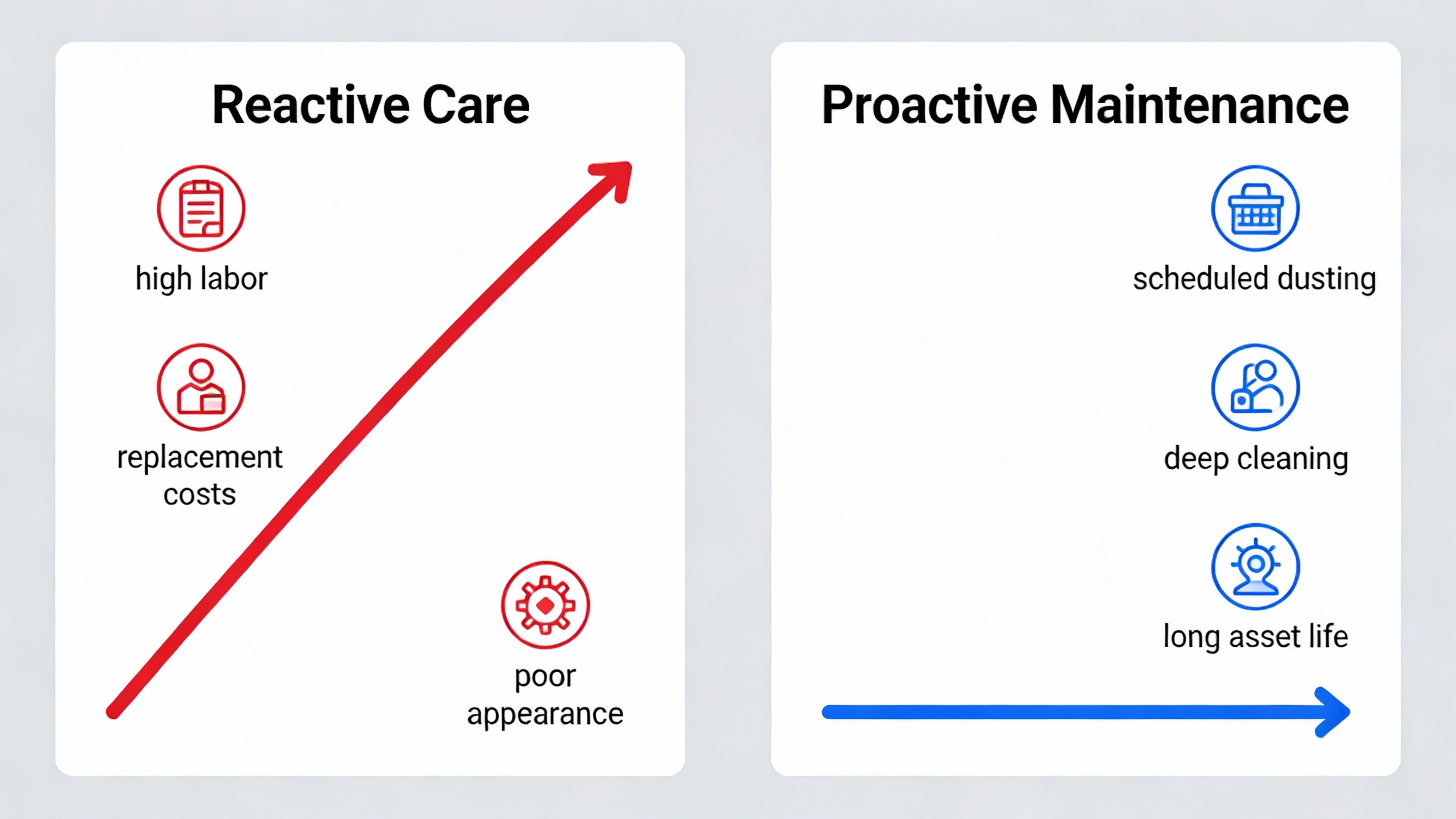
6. A simple maintenance rhythm works better than heavy rescue cleaning
For most retail and hospitality projects, we suggest a routine like this:
| Timing | What the team usually does | Why it helps |
|---|---|---|
| Weekly or bi-weekly | Light dusting and quick shape reset | Keeps buildup from becoming visible too early |
| Monthly | Check touch points, pots, and damaged leaves | Catches small issues before the display looks tired |
| Quarterly | Deeper clean by material type and placement | Reduces the need for full replacement |
| Before major seasonal resets | Review whether replacement or spare pieces are needed | Keeps the display commercially usable through the next cycle |
This is usually more practical than waiting until the plant looks dirty and then trying to recover it in one heavy cleaning round.
7. What we usually prepare for buyers before order
When the project is serious, we usually help clarify:
- indoor or higher-exposure use environment
- material direction and cleaning sensitivity
- expected maintenance level for the site team
- sample policy and production consistency
- mixed-order support if the project includes leaves, flowers, or other decorative items
The goal is simple: help the buyer choose a product direction that looks commercial and stays manageable after installation.
Conclusion
Good maintenance starts with the right product choice, not only with the cleaning team after delivery.
If you tell us where the faux plants will be used, how often the display changes, and how much routine cleaning the site team can realistically handle, we can usually recommend a more practical direction before sample or bulk order.
If you want the fastest follow-up, use Send Inquiry.
For broader range review, continue with Products.
For supplier and export discussion, continue with Wholesale of Artificial Plants.

Hello everyone, I'm Li!By day, I'm a seasoned expert in the artificial plant industry, starting from the factory floor and working my way up to running my own successful business. In my free time, I’m passionate about running and often join trail runs with friends.Here to share what I've learned—let's grow together!