To import artificial plants from China, first define the products and target market. Then compare suppliers by capability, approve samples, confirm MOQ and packing, inspect the order, and calculate landed cost before booking freight.
Your total import cost is more than the product price. It may include samples, customization, export packing, inland transport in China, inspection, international freight, insurance, import duty, tax, customs clearance, and destination charges.
From our side as a supplier, projects move faster when the buyer shares the destination country, product categories, quantity range, application, and sample needs at the start.
Quick Answer
Quick answer: how to import artificial plants from China
- Define the product categories, target market, quality level, and working quantity.
- Shortlist suppliers that can support the products, customization, packing, and mixed-order structure you need.
- Verify the company, production capability, export experience, and quality-control process.
- Approve samples and confirm specifications before bulk production.
- Confirm MOQ, price basis, packing, payment terms, Incoterm, and production schedule in writing.
- Inspect the finished order and verify carton details before shipment.
- Compare freight and destination charges using the final carton count, dimensions, weight, and volume.
What does it cost to import artificial plants from China?
There is no useful fixed import cost without a product list and destination. Artificial flowers, small potted plants, green wall panels, and custom large trees have very different packing volumes and shipping requirements.
Use this cost structure when comparing quotations:
| Cost item | What to confirm |
|---|---|
| Product and customization | Style, material, size, color, finish, custom molds or structures, and quantity by item |
| Samples | Sample price, sample packing, courier charge, and whether any sample cost can be credited to a later order |
| Export packing | Inner protection, master cartons, pallets or crates, labels, shipping marks, and retail-ready packing if required |
| China-side charges | Inland transport, loading, export documents, inspection, and any consolidation charge |
| International freight | Express, air, rail, LCL, or full-container freight based on final carton data |
| Insurance | Cargo value, route, packing risk, and whether the buyer, supplier, or forwarder arranges coverage |
| Destination charges | Customs broker, terminal or port handling, delivery, storage, and other local service charges |
| Duty and tax | Product classification, declared value, origin, destination-country tariff, and local tax rules |
Ask suppliers to separate the product price, packing, Incoterm, and known China-side charges. Ask your freight forwarder or customs broker to confirm current freight, duty, tax, and destination costs. This is more reliable than comparing unit prices alone.
Step 1: Define what you want to import

Before comparing suppliers, define the basic sourcing scope. If your first inquiry already explains the product categories and target market, we can narrow the range faster instead of sending a generic catalog.
What we usually confirm first
- Target market: The United States, the United Kingdom, Australia, Denmark, and the Middle East may need different styles, packing methods, and product mixes.
- Product category: Artificial cactus, large trees, green walls, leaves, real-touch flowers, decorative ornaments, and pine trees follow different MOQ and shipping logic.
- Buyer type: Wholesale distribution, retail resale, hospitality projects, and event decoration usually need different assortments.
- Order structure: A single-category order and a mixed shipment need different carton and freight planning.
- Price range: A trial order and a long-term replenishment program need different product and quotation strategies.
The clearer this first step is, the easier it is for us to recommend relevant products instead of asking you to sort through unrelated styles.
Step 2: Shortlist the right type of supplier
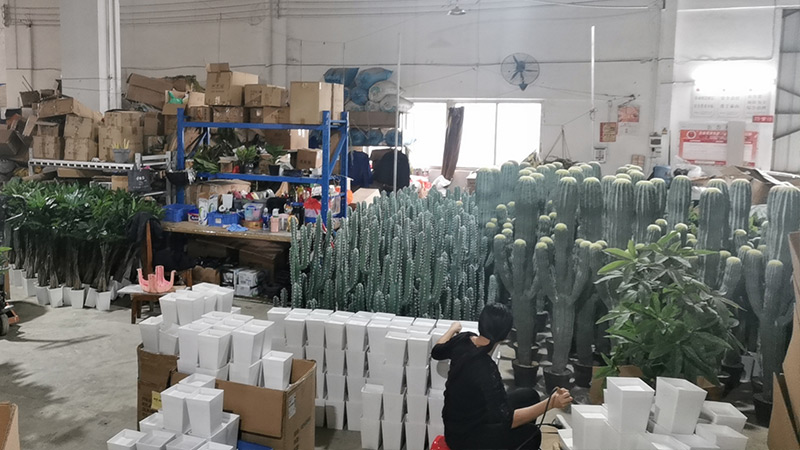
China has many artificial plant suppliers, but they do not all suit the same type of order. Start by checking whether a supplier fits your products and order structure, not only whether it offers the lowest unit price.
Where buyers usually find suppliers
- B2B platforms such as Alibaba and Made-in-China
- trade fairs such as the Canton Fair
- factory or industry referrals
- sourcing agents or local teams in China
- industry contacts with repeat import experience
What to compare when shortlisting suppliers
| Item | Why it matters |
|---|---|
| Product focus | Some suppliers specialize in plants, while others focus on flowers, large trees, or mixed decor. |
| Export communication | Fast replies are not enough. The supplier must answer clearly about MOQ, samples, packing, and lead time. |
| Production capacity | Stable production and delivery matter more when a trial order becomes a repeat program. |
| Custom capability | Hotels, commercial spaces, and project buyers often need changes to size, color, or structure. |
| Mixed-order support | A supplier that can combine categories can reduce sourcing and shipping coordination. |
The goal is not to find the cheapest quote first. It is to find a supplier that can support your assortment, quality requirements, and shipping plan.
Step 3: Verify supplier capability
Before discussing samples or deposits, confirm that the supplier can handle the order you need. This step can reduce rework and communication problems later.
What to verify
- Company legitimacy: registration, basic company details, and export background
- Factory or workshop evidence: real production photos, videos, video audits, or inspection reports
- Product experience: whether the supplier regularly makes the same or similar categories
- Sample capability: whether it can prepare samples and explain the materials, structure, and differences
- Packing capability: whether it understands packing for fragile, small, oversized, or custom products
- Bulk consistency: whether mass production can match the approved sample
If you cannot visit the factory, use video verification, third-party inspection, and sample approval to reduce risk.
Step 4: Confirm price, MOQ, and payment terms
Once the supplier is a good fit, move to the commercial terms. We usually suggest confirming MOQ and the sample process before comparing final landed costs in detail.
What to confirm early
- MOQ by category or style
- whether multiple styles can be combined in one order
- sample charges and sample preparation
- the bulk production schedule
- deposit and balance payment structure
- Incoterms such as FOB or CIF
- extra charges for labels, inner packing, custom colors, or structural changes
The more specific the inquiry, the easier it is for a supplier to provide a quotation that supports a real buying decision.
Step 5: Plan shipping and customs early
Do not wait until production is complete to think about shipping. Carton dimensions, volume, and packing method directly affect freight cost and margin.
Common shipping methods
| Method | Relative cost | Typical use | Planning point |
|---|---|---|---|
| Express | Very high | samples or very small urgent shipments | Confirm courier limits and destination charges before dispatch. |
| Air freight | High | smaller commercial orders with a firm deadline | Compare chargeable weight, carton dimensions, and airport-side charges. |
| Sea freight | Lower for volume cargo | wholesale and project orders | Compare LCL and full-container options using the final shipment volume. |
| Rail freight | Route-dependent | some Europe-bound orders | Confirm current routes, transfer points, and delivery scope. |
What to confirm before shipment
- HS code and basic customs classification
- destination-country duties and local taxes
- whether you need a customs broker
- carton dimensions, total weight, and total volume
- whether oversized or fragile products need special packing or handling
- whether the shipment contains one category or a mixed order
Good freight planning usually starts before production ends.
Step 6: Inspect before shipment
Pre-shipment inspection can reduce quality disputes, returns, and freight losses. Match the inspection scope to the order value, product structure, and level of customization.
What to inspect
- whether bulk goods match the approved sample
- material, finish, and color consistency
- plant shape, fullness, and assembly details
- carton count and assortment accuracy
- packing and inner protection
- shipping marks and outer-carton labels
Common inspection methods
- third-party pre-shipment inspection
- supplier inspection with product and loading photos or videos
- random carton checks
- factory audits for long-term buyers or larger orders
The more fragile or customized the product, the less sense it makes to skip this step.
Step 7: Plan replenishment, not only the first order
The first shipment is only one part of the supplier relationship. If you plan long-term wholesale or project sourcing, discuss replenishment during the first order.
Questions to consider early
- Which styles will remain in the range?
- Can later orders maintain the same quality and color?
- What production planning will replenishment need?
- Can new styles be added to the existing assortment?
- Do you need a second supplier as a backup?
Buyers who plan replenishment early usually make better first-order decisions.
Step 8: Monitor regulations and trade policies
Tariffs, labeling rules, material standards, and e-commerce platform requirements can change. These changes may affect import costs and sales.
What to review regularly
- tariff and trade-policy changes
- local safety and material requirements
- labeling and packing rules
- environmental or restricted-material rules
- platform rules and local tax requirements if you sell online
This review is especially important when importing into several markets.
Why China remains a practical sourcing base for artificial plants
China's artificial plant supply chain can support different product categories, production scales, customization, and export packing. For importers, the value is not only production cost. It is also the ability to compare categories, approve samples and packing, and build a repeat-order process within one sourcing system.
Our range includes real-touch artificial flowers, artificial potted plants, custom fiberglass trees, artificial cactus, and artificial landscape ornaments. We can combine different categories and products in one consolidated shipment.

Mixed orders may include:
- artificial plants with real-touch flowers
- green wall panels with artificial leaves
- decorative ornaments with pine trees
- custom large trees with supporting decor
Import FAQ
What is the MOQ for artificial plants?
There is no single MOQ for every product. MOQ depends on the style, material, color, customization, packing method, and whether several products can be combined. Select the products you need from our catalog, and we will confirm the MOQ for each item.
Should I order samples before a bulk order?
If you have strict requirements, we recommend ordering samples first, especially when color matching or custom sizes are involved. A sample should confirm the product specification and packing direction, not only the appearance.
Which shipping method is best for artificial plants?
Express is normally used for samples, air freight for smaller urgent commercial orders, and sea freight for larger shipments. The right choice depends on the deadline, carton dimensions, weight, volume, destination charges, and damage risk.
How do I estimate landed cost?
Add the product, customization, samples, packing, China-side charges, inspection, international freight, insurance, duty, tax, customs clearance, destination handling, and final delivery. Use final carton data and ask your freight forwarder or customs broker to confirm current local charges.
Can different artificial plant categories ship together?
Usually, yes. Plants, flowers, leaves, decorative ornaments, pine trees, and other decor can form a mixed order. MOQ, carton protection, labels, and loading must still be checked by category before the order is confirmed.
What information should I send for a quotation?
Send the destination country, product categories or reference images, quantity range, size or color requirements, sample needs, packing requirements, shipping method, and trade terms.
Conclusion
Before importing artificial plants from China, confirm the product types, quantities, and trade terms.
If you are already selecting products, checking MOQ, or working with your own freight forwarder, you can use the sourcing pages below. You do not need to finalize every detail before contacting us.

Hello everyone, I'm Li!By day, I'm a seasoned expert in the artificial plant industry, starting from the factory floor and working my way up to running my own successful business. In my free time, I’m passionate about running and often join trail runs with friends.Here to share what I've learned—let's grow together!